
Introduction
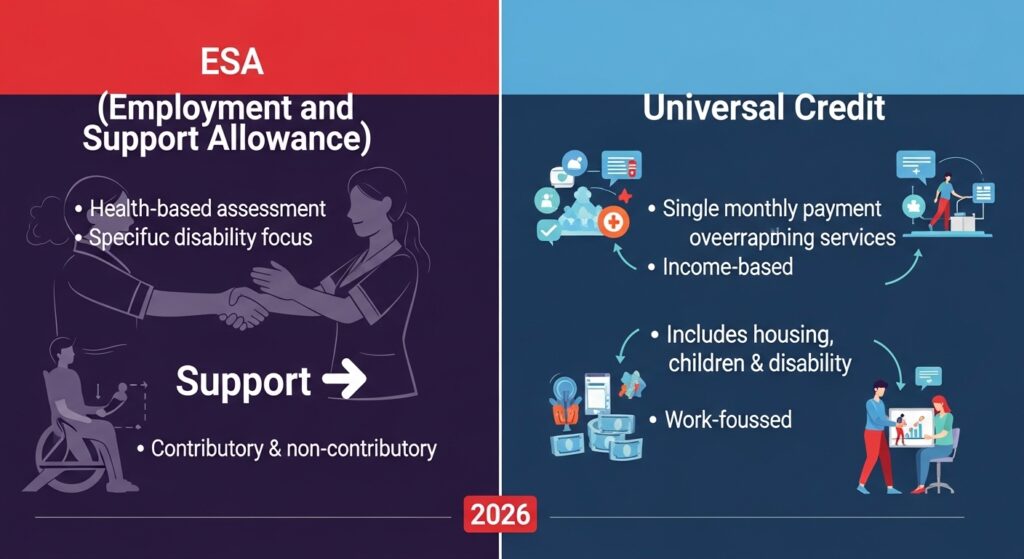
Understanding the differences between Employment and Support Allowance (ESA) and Universal Credit (UC) can be confusing. Both benefits provide financial support to people with health conditions or disabilities who cannot work, but they differ in eligibility, assessment, payment, and additional elements.
This guide explains the distinctions clearly, helping you make informed decisions, claim the right benefit, and understand the UK 2026 rules.
Focus Keyword: ESA vs Universal Credit
Secondary Keywords: new style ESA, employment support allowance UK

Overview of ESA
Employment and Support Allowance (ESA) provides financial support to people who:
- Have a long-term illness or disability that limits work
- Are aged 16 or over
- Do not qualify for Universal Credit or are in a transitional arrangement
There are two types of ESA:
- Contribution-based ESA:
- Based on National Insurance contributions
- Paid regardless of savings or income
- Income-related ESA:
- Means-tested, considering income and savings
- Can be claimed alongside Universal Credit transitional rules
Official Reference: GOV.UK – ESA
Overview of Universal Credit
Universal Credit (UC) is a single monthly payment replacing multiple benefits, including:
- Income-based ESA
- Income Support
- Housing Benefit
- Child Tax Credit
- Working Tax Credit
- Jobseeker’s Allowance (income-based)
Key UC Features:
- Single payment per household
- Digital-first system: online applications and updates
- Disability element available for those with LCW or LCWRA
- Monthly payments directly to claimants
Official Reference: GOV.UK – Universal Credit

Eligibility Differences
| Feature | ESA | Universal Credit (Disability Element) |
|---|---|---|
| Age | 16–64 | 16+ |
| Health Condition | Must limit ability to work | Must have LCW or LCWRA |
| Means Test | Depends on contribution type | Always means-tested for UC payment calculation |
| Work Capability Assessment | Mandatory | Mandatory for LCW/LCWRA determination |
| Additional Elements | None (except premiums) | Disability, LCWRA, childcare, housing element |
Example:
Emma, 40, has severe arthritis. She previously claimed ESA contribution-based, but now she also qualifies for UC with the disability element, covering extra living costs.
Payment Differences
ESA Rates (2026):
- Assessment Phase: £81.10–£90.50/week
- Main Phase (Support Group): £124.45/week
- Work-Related Activity Group: £94.00/week
UC Disability Element Rates (2026):
- Standard Disability Element: £169.20/week
- LCWRA Element: £338.10/week
UC often provides higher total support, especially when combined with other elements (housing, children, childcare).
Assessment Process
ESA Assessment
- Work Capability Assessment (WCA) determines eligibility
- Focus on functional limitations, daily living activities, and work-related capabilities
- Outcome: Support Group or Work-Related Activity Group
UC Assessment
- LCW / LCWRA Assessment
- Determines whether you qualify for the disability element
- Includes a medical questionnaire and possibly face-to-face consultation
PIP Assessment Tips for guidance on handling health assessments
Claiming ESA vs UC
ESA
- Call the DWP ESA line or apply online (for contribution-based ESA)
- Complete health questionnaires
- Submit evidence (medical letters, GP notes)
- Attend WCA if required
UC
- Apply online via GOV.UK Universal Credit
- Complete health and daily living questionnaire
- Provide medical evidence if required
- Wait for LCW or LCWRA decision
Tip: Some claimants transition from ESA to UC automatically. Check your eligibility carefully.

Interaction With Other Benefits
- ESA: Can work with Pension Credit, Housing Benefit (if income-related)
- UC: Replaces multiple benefits, but includes additional elements like childcare or disability support
Common Mistakes to Avoid
- Claiming ESA when UC is more appropriate
- Not providing sufficient medical evidence
- Ignoring transitional arrangements if previously on ESA
- Overlooking additional UC elements (housing, childcare, disability)
Example: Liam, aged 50, continued claiming ESA without switching to UC. He missed out on higher disability and housing elements.
Tips for Approval
- Keep a daily diary of limitations and medical appointments
- Collect GP letters and specialist reports
- Highlight safety and mobility concerns
- If switching from ESA to UC, notify DWP promptly
Summary
ESA vs Universal Credit can be confusing, but the main differences are:
- UC combines multiple benefits into a single monthly payment
- ESA may still be useful for contribution-based claims or transitional arrangements
- UC often provides higher overall support, especially with disability elements
- Proper documentation, medical evidence, and accurate claims increase the chance of approval
Understanding these differences ensures you claim the right benefit and maximize support.
Disclaimer
Disclaimer:
This guide provides informational purposes only. Always verify eligibility, payment rates, and processes via official GOV.UK resources. This article does not constitute legal, medical, or financial advice.