
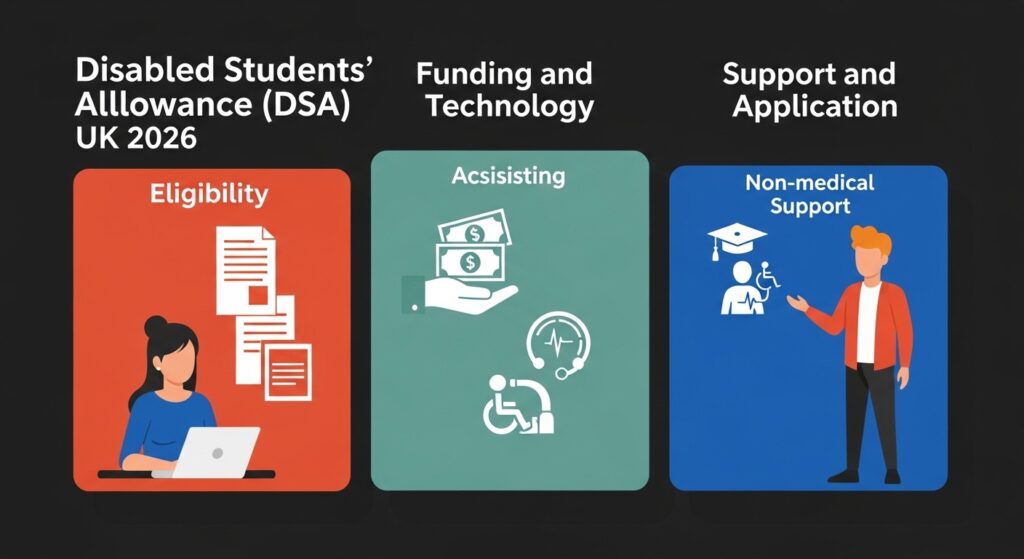
Disabled Students’ Allowance (DSA) is a government-funded grant that helps students with disabilities meet extra costs caused by their condition while studying in higher education. This guide explains everything you need to know in 2026—from eligibility and application steps to assistive technology, funding, and support services.

What Is Disabled Students Allowance (DSA)?
DSA is not a loan—it is financial support that helps students with:
- Assistive technology and software
- Specialist tutors or note-taking services
- Travel costs for mobility-impaired students
- Adaptive study equipment
It is available to eligible students across England, Scotland, Wales, and Northern Ireland.
Who Is Eligible for DSA in 2026?
To qualify, students must:
- Be enrolled in higher education (university or college).
- Have a disability, long-term health condition, mental health condition, or specific learning difficulty such as dyslexia.
- Need additional support to access learning effectively.
Eligibility is based on need, not severity.
Types of Support Covered by DSA
1. Specialist Equipment
- Laptops, tablets, and adaptive keyboards
- Screen readers and text-to-speech software
- Hearing aids and FM systems
- Ergonomic chairs and study desks
2. Non-Medical Helper Support
- Sign language interpreters
- Specialist study skills tutors
- Note-takers for lectures
- Personal assistants for academic tasks
3. Travel Allowance
Students with mobility issues can claim travel expenses if public transport isn’t suitable.
Step-by-Step Guide to Applying for DSA
Step 1: Gather Evidence
Provide evidence of your disability through:
- Doctor’s letter
- Educational psychologist report
- Specialist assessment for learning difficulties
Step 2: Complete the Application
- Apply online via the Student Finance portal in your region.
- Submit supporting medical or educational evidence.
Step 3: Attend a Needs Assessment
- Conducted by a specialist assessor
- Determines recommended equipment and support
- Produces a DSA Support Recommendation Report
Step 4: Receive Funding and Support
- Approval letters and instructions to order equipment
- Access to approved support services
- DSA is non-repayable
Common Questions About DSA
How Much DSA Can I Receive?
- Full-time undergraduates can get up to £5,000 for equipment and £20,000 for non-medical support during their studies.
Can I Use DSA for Private Courses or Tutoring?
- No, DSA is restricted to higher education study-related expenses.
How Long Does It Take to Get DSA?
- From application to funding approval: 6–12 weeks.
Can Part-Time Students Get DSA?
- Yes, funding is proportional to study hours.
Tips for Maximising Your DSA Benefits
- Apply early.
- Keep all medical and educational documentation.
- Request a full needs assessment.
- Reassess annually if your support needs change.
DSA and Assistive Technology
Popular tools supported by DSA:
| Tool | Purpose | Notes |
|---|---|---|
| Kurzweil 3000 | Text-to-speech | Supports dyslexia & learning difficulties |
| Read&Write | Writing assistance | Spell check, word prediction, audio |
| Dragon NaturallySpeaking | Voice recognition | Speech-to-text |
| ClaroRead | Reading & writing | Microsoft Office integration |
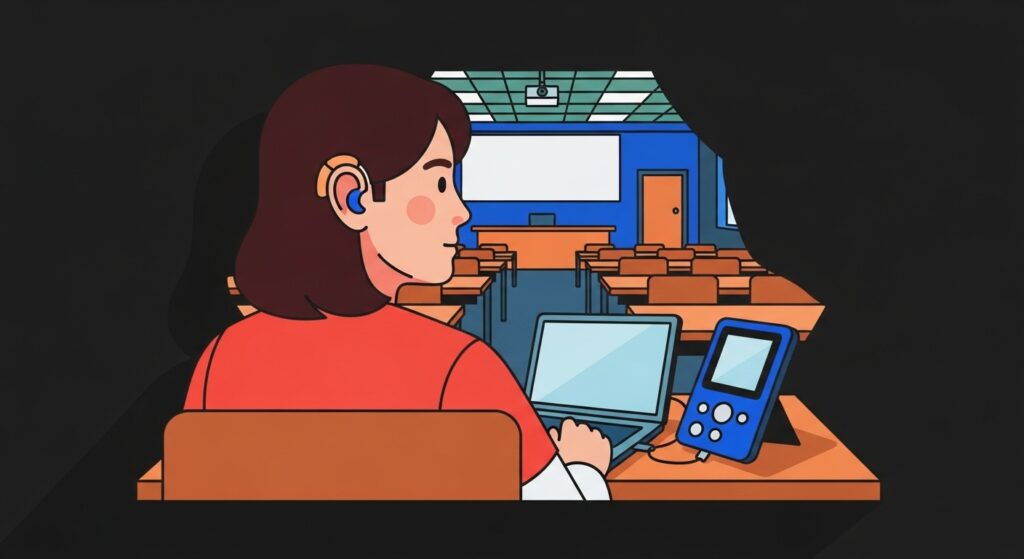
These technologies help students take notes, complete assignments, and participate in classes independently.
Benefits of DSA in 2026
- Financial relief – fully funded support
- Equal access – enables participation in all learning activities
- Independence – reduces reliance on constant support
- Academic success – improves learning, comprehension, and confidence
Challenges and Considerations
- Assessment delays
- Difficulty obtaining comprehensive evidence
- Limited availability of certain high-tech equipment
Tip: Contact your university Disability Support Service early.
Additional Support for Disabled Students
- University bursaries – Many universities provide extra financial support.
- Charity grants – RNIB, Scope, Mind support students financially or with assistive tech.
- Assistive technology loans – Some UK vendors offer student discounts or device loans.
Tips:
- Assistive Technology for Disabled Students in the UK – Tools, Grants & 2026 Guide → in the assistive tech sections
- UK Disability Grants & Funding Options for 2026 → in the “Funding” section
- How to Get Home Care Support in the UK – Eligibility, Costs & Process (2026) → under DSA travel/support section
- Scholarships for Disabled Students UK → link when discussing bursaries
- Accessible UK Cities & Transport for Disabled Students → in travel/mobility section
FAQ
Q1: What is Disabled Students Allowance (DSA)?
A1: DSA is a government grant for disabled students to cover costs such as assistive technology, specialist tutors, and travel while studying in the UK.
Q2: Who is eligible for DSA in 2026?
A2: Students enrolled in UK higher education with a disability, long-term health condition, or specific learning difficulty.
Q3: Does DSA need to be repaid?
A3: No, it is a non-repayable grant.
Q4: How long does it take to get DSA approved?
A4: Usually 6–12 weeks, depending on documentation and assessment scheduling.
Q5: Can part-time students get DSA?
A5: Yes, funding is proportionally adjusted based on study hours.