
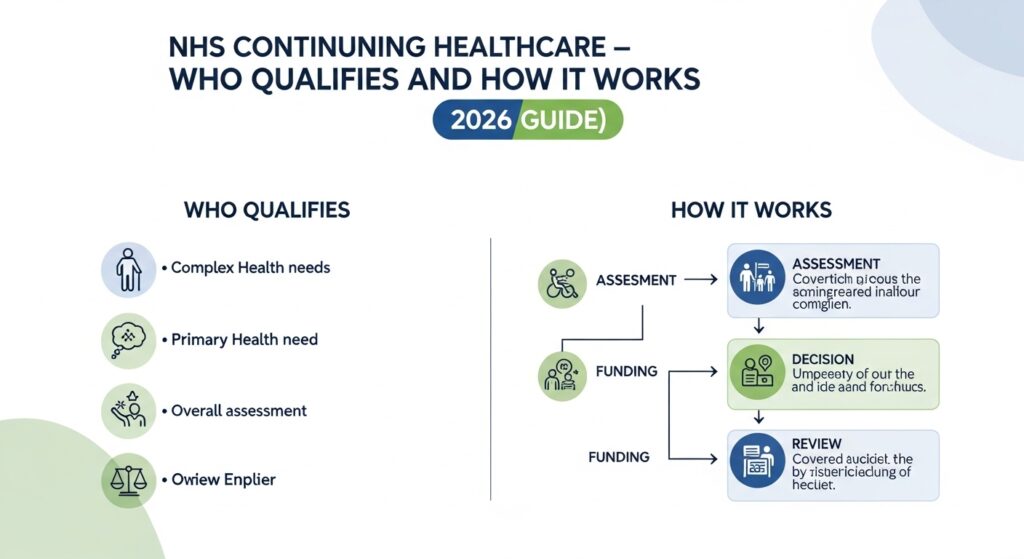
Paying for long-term care in the UK can be extremely expensive. Many families assume they must sell property or use savings to fund care home costs. However, in some cases, the NHS is legally responsible for covering the full cost of care.
This support is called NHS Continuing Healthcare.
It is not means-tested. It is based entirely on health needs. Yet many eligible people never apply or are wrongly refused.
This guide explains who qualifies, how the assessment works, and what to do if a claim is rejected.

What Is NHS Continuing Healthcare?
NHS Continuing Healthcare (often shortened to CHC) is a package of care funded entirely by the NHS for adults with significant ongoing health needs.
If approved, the NHS pays for:
- Care home fees
- Nursing home costs
- Carers in your own home
- Specialist equipment
- Healthcare support
There is no financial assessment. Your income and savings do not matter.
The only question is whether you have a “primary health need.”
What Does “Primary Health Need” Mean?
This is the key test.
A primary health need means your care requirements are mainly due to health conditions rather than social care needs.
The NHS looks at:
- Nature of needs
- Intensity of support required
- Complexity of conditions
- Unpredictability of symptoms
It is not about diagnosis alone. It is about the level of ongoing care required.
Who Might Qualify?
People with conditions such as:
- Advanced dementia
- Parkinson’s disease
- Multiple sclerosis
- Severe stroke damage
- Motor neurone disease
- Complex neurological conditions
- End-stage cancer
- Severe learning disabilities with complex needs
However, no condition automatically qualifies. The decision is based on care requirements.
NHS Continuing Healthcare vs Social Care
This distinction is critical.
Social care (means-tested by local councils) covers:
- Help with washing and dressing
- Support with daily tasks
- Residential care
Healthcare (funded by the NHS) covers:
- Ongoing nursing needs
- Complex medical monitoring
- Regular clinical intervention
If your needs are mainly medical, the NHS may be responsible.

How the Assessment Process Works
There are several stages.
Step 1: Checklist Assessment
A nurse, GP, social worker or other professional completes a screening checklist.
If the checklist score meets the threshold, you move to the next stage.
You have the right to request a checklist if you believe eligibility may apply.
Step 2: Full Assessment (Decision Support Tool)
If you pass the checklist, a full assessment is carried out using the Decision Support Tool (DST).
This reviews needs across several domains, including:
- Behaviour
- Cognition
- Psychological needs
- Communication
- Mobility
- Nutrition
- Continence
- Skin integrity
- Breathing
- Medication management
- Altered states of consciousness
Each area is graded from low to priority level.
A “priority” score in one area or severe scores in multiple areas can lead to eligibility.
Step 3: Multidisciplinary Team Decision
A panel reviews the assessment and decides whether you meet the primary health need criteria.
The decision should consider:
- Totality of needs
- Risk factors
- Evidence from medical professionals
You must receive a written explanation of the outcome.
How Much Does NHS Continuing Healthcare Pay?
If approved, it covers the full cost of care.
This can include:
- £1,000 to £1,500 per week for care homes
- Higher amounts for specialist nursing facilities
- Full home care packages
There is no upper financial limit.
What Is NHS-Funded Nursing Care?
If you do not qualify for full Continuing Healthcare but live in a nursing home, you may qualify for NHS-funded nursing care (FNC).
This is a fixed weekly payment made by the NHS toward nursing costs.
It does not cover full care home fees, but it reduces the overall cost.
Fast-Track Pathway for Terminal Illness
If someone has a rapidly deteriorating condition and may be entering the final stage of life, the NHS can fast-track the application.
This allows immediate funding without going through the full checklist process.
Fast-track decisions are based on clinical judgement.
Common Reasons for Refusal
Many applications are refused because:
- Evidence is not detailed enough
- Needs are described as “social” rather than medical
- The checklist was not completed thoroughly
- Documentation lacks supporting clinical records
Families often underestimate the level of detail required.
Can You Appeal a Decision?
Yes.
If refused, you can:
- Request a local review
- Escalate to NHS England if necessary
- Seek independent advice
Appeals can take time but are successful in some cases, especially where documentation improves.
Can Funding Be Withdrawn?
Yes.
Eligibility is reviewed periodically.
If your condition improves, funding may stop.
If your needs increase, the package can be adjusted.
How Long Does the Process Take?
Timeframes vary.
Checklist stage: Often within weeks.
Full assessment: Can take several months depending on backlog.
Delays are common, so early application is important.
Does Property Ownership Matter?
No.
Unlike local authority funding, your house, savings and pension do not affect eligibility.
This is one reason why CHC is so significant financially.
Practical Tips for Families
- Request a checklist if not offered
- Attend assessment meetings
- Keep detailed care notes
- Provide hospital records
- Challenge vague wording
- Focus on medical complexity
Clear documentation is critical.
Interaction With Other Benefits
If you qualify for NHS Continuing Healthcare:
- Attendance Allowance usually stops after 28 days in a care home
- Pension Credit may adjust
- Other benefits may change
Always inform relevant departments if funding is approved.

Is It Worth Applying?
Yes, if health needs are significant.
Because funding is not means-tested, it can prevent families from using savings unnecessarily.
However, the process requires persistence.
Final Thoughts
NHS Continuing Healthcare is one of the most misunderstood forms of support in the UK. It exists for people whose care needs are primarily medical rather than social.
If you believe the NHS should be responsible for funding care, request a checklist assessment. Even if initially refused, you have the right to challenge decisions.
Understanding the criteria gives you a stronger position during the assessment process.
Disclaimer
This article is for general informational purposes only and does not constitute legal or financial advice. NHS policies and assessment procedures may change. Always consult official NHS guidance or seek independent advice before making decisions. FreedomMove is not affiliated with the NHS and does not guarantee eligibility outcomes.
Tip : Link below for more information !
Disabled Facilities Grant guide