
If you live with a long-term health condition that affects how you move or travel, the Personal Independence Payment (PIP) Mobility Component can provide financial support.
But many people in the UK find the system confusing. The rules are not always explained clearly, and small mistakes in the application can lead to rejection.
This guide breaks everything down in plain English so you understand how the mobility part works, how points are awarded, and what actually matters when you apply.

What Is the PIP Mobility Component?
PIP is a benefit for people aged 16 to State Pension age who have a long-term physical or mental health condition that affects daily life.
It has two separate parts:
- Daily Living Component
- Mobility Component
You can receive one or both, depending on how your condition affects you.
The Mobility Component looks specifically at how your condition impacts:
- Your ability to plan and follow journeys
- Your ability to move around physically
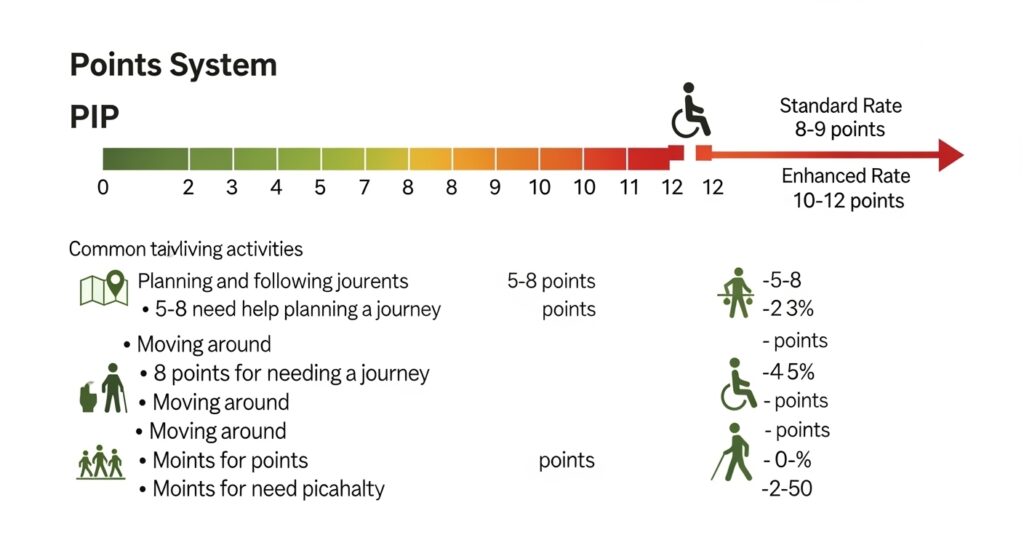
You are scored using a points-based system.
How Much Is the Mobility Component?
There are two payment levels:
Standard Rate
Awarded if you score 8–11 points.
Enhanced Rate
Awarded if you score 12 points or more.
Payment rates are reviewed annually, so always check current figures before publishing exact amounts. If awarded Enhanced Mobility, you may also qualify for additional support such as the Motability Scheme or automatic Blue Badge eligibility.
How the Points System Works
You do not get points for having a diagnosis.
You get points for how your condition affects your functional ability.
There are two mobility activities.
Activity 1: Planning and Following Journeys
This section mainly applies to people whose condition affects their ability to go out safely or independently.
It includes mental health conditions, cognitive impairments, neurological disorders, and sensory impairments.
The system looks at whether you can:
- Plan a journey
- Follow a route
- Travel without overwhelming psychological distress
- Travel safely
Example Descriptors and Points
- 0 points: Can plan and follow journeys unaided
- 4 points: Needs prompting to undertake a journey
- 8 points: Cannot follow the route of an unfamiliar journey without another person
- 10 points: Cannot undertake any journey due to overwhelming psychological distress
- 12 points: Cannot follow the route of a familiar journey without assistance
Overwhelming psychological distress must be significant. Feeling mildly anxious does not qualify. The distress must prevent you from reliably travelling most of the time.
Conditions often assessed under this section include:
- Severe anxiety disorders
- PTSD
- Autism spectrum conditions
- Learning disabilities
- Dementia
- Severe depression
Activity 2: Moving Around
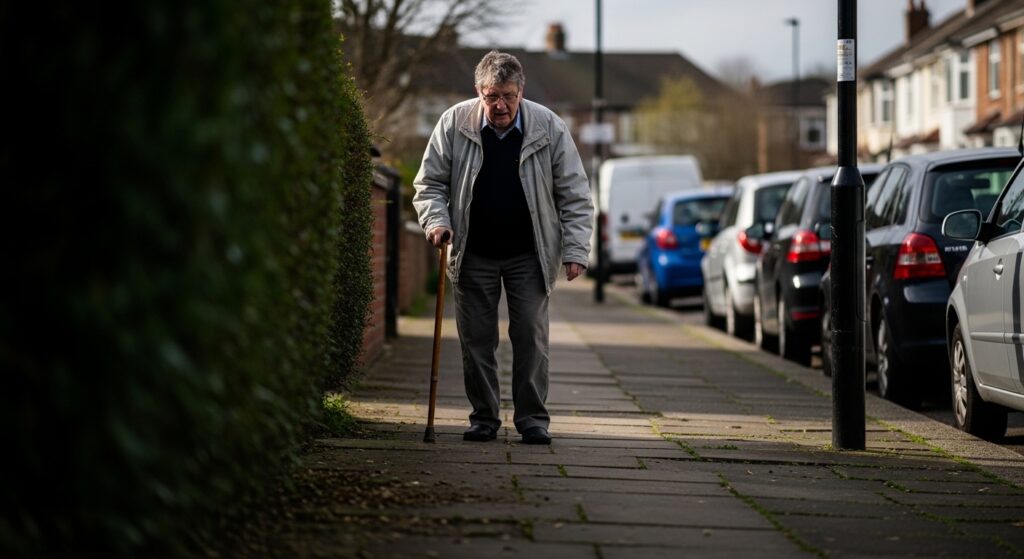
This section measures how far you can walk.
Distance is extremely important.
The assessment considers how far you can walk safely, reliably, repeatedly, and in a reasonable time.
Points Breakdown
- 0 points: Can stand and move more than 200 metres
- 4 points: Can stand and move between 50 and 200 metres
- 8 points: Can stand and move between 20 and 50 metres
- 10 points: Can stand and move no more than 20 metres
- 12 points: Cannot stand or move more than 1 metre
If you cannot walk more than 20 metres reliably, you may qualify for Enhanced Mobility.
This is one of the most important thresholds in the system.
What “Reliably” Really Means
Many people misunderstand this.
You must be able to complete the activity:
- Safely
- To an acceptable standard
- Repeatedly
- Within a reasonable time
If you can technically walk 30 metres but:
- You are in severe pain
- You must stop several times
- It takes much longer than someone without your condition
- You cannot repeat it shortly afterwards
Then it may not count as being able to walk that distance reliably.
This is where detailed explanations matter.
Realistic Examples
Example 1: Severe Knee Arthritis
Can walk 25 metres with a stick. Must stop after 10–15 metres due to pain. Takes over 2 minutes to cover that distance. Needs 10 minutes rest afterwards.
Likely 8–10 points.
Example 2: COPD
Can walk 40 metres slowly but becomes severely breathless and dizzy. Cannot repeat it without long recovery.
Likely 8 points.
Example 3: Severe Social Anxiety
Cannot leave home alone due to panic attacks. Experiences overwhelming distress when attempting travel.
May score 10–12 points under planning and following journeys.
Why Applications Get Rejected
Many claims fail because:
- The form focuses on diagnosis rather than functional impact
- Walking distance is not clearly described
- No examples of bad days are provided
- Answers are inconsistent
- Medical evidence does not support the claim
The decision maker is not judging how serious your condition sounds. They are judging how it affects your mobility in measurable terms.
How to Describe Your Mobility Properly
Avoid vague statements like:
“I struggle to walk.”
Instead write:
“I can walk approximately 20–30 metres using a walking stick. After around 15 metres, I experience severe hip pain and must stop. It takes me significantly longer than someone without my condition. I need at least 10 minutes rest before attempting to walk again.”
Specific detail makes a difference.
Include:
- Distance
- Pain level
- Speed
- Recovery time
- Whether you use aids
- Whether you fall or feel unsafe
The Assessment Process
Most people attend a telephone, video, or face-to-face assessment.
You may be asked:
- How far can you walk before stopping?
- Do you use mobility aids?
- Can you use public transport alone?
- Do you avoid leaving the house?
Answer honestly and consistently with what you wrote in the form.
Do not downplay your difficulties out of habit.
Can You Appeal?
Yes.
If your claim is refused or you receive fewer points than expected:
- Request a Mandatory Reconsideration
- Appeal to a tribunal if necessary
A significant number of decisions are changed at tribunal when proper evidence is presented.
If your condition worsens, you can also report a change.

How PIP Mobility Links to Other Support
If awarded Enhanced Mobility, you may qualify for:
- The Motability Scheme
- Automatic Blue Badge eligibility
- Vehicle tax reduction
You can internally link this section to your Blue Badge guide and mobility equipment content.
Practical Tips Before You Apply
- Keep a short diary of your mobility for 1–2 weeks
- Ask your GP or consultant for a supporting letter
- Be clear about your worst days
- Do not exaggerate, but do not minimise
- Focus on impact, not diagnosis
The system is structured. Your answers need to match the structure.
Key Points to Remember
- 8 points = Standard rate
- 12 points = Enhanced rate
- 20 metre threshold is crucial
- Psychological distress can qualify
- Reliability rules are central
- Appeals are common
Understanding the rules gives you a stronger chance of a fair outcome.
Conclusion
The PIP Mobility Component exists to support people whose ability to move or travel is significantly restricted by long-term health conditions.
The award is not based on how serious a diagnosis sounds. It is based on measurable functional limitations.
Clear, specific, evidence-based applications are far more likely to succeed.
If you believe your mobility is affected, take the time to complete the form carefully and provide proper detail.
Disclaimer
This article is for informational purposes only. Decisions about Personal Independence Payment are made by the Department for Work and Pensions following individual assessment. Eligibility criteria and payment rates may change. We are not affiliated with the DWP. If you choose to purchase mobility-related products mentioned on this website, you do so at your own discretion. FreedomMove is not responsible for benefit decisions or product performance.